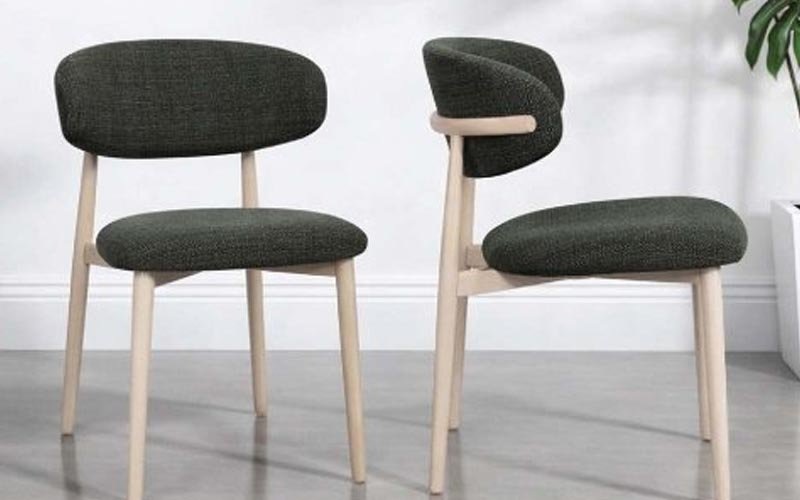
A cafe inside a stadium serves perhaps forty covers on an ordinary Tuesday. On a match day it serves two thousand. Averaged across a year, the traffic looks modest, which is exactly how these rooms end up furnished from an averaged number and rebuilt within four seasons.
Operators who have been through that cycle once specify restaurant chairs rated for the peak rather than for the average and they specify them at a multiple that looks absurd on paper. The reasoning is straightforward once the arithmetic is laid out, and it applies to any venue whose demand arrives in bursts.
Averages Describe a Day That Never Happens
Start with why the ordinary planning number misleads.
A room serving forty covers most days and two thousand fifteen times a year averages out to something like a hundred and thirty. No day resembles that figure. The furniture spends most of its life almost unused and the rest of it under a load fifty times higher, and it is the second condition that determines when it fails.
Fatigue does not average. A chair that takes two thousand sits in six hours has absorbed more cycles in one afternoon than it would in seven weeks of normal trading. It absorbs them from a crowd that is standing, moving and in a hurry.
The Peak Is Harsher As Well As Bigger
Volume is only half of it, and the other half does more damage.
Match day crowds sit fast and stand fast. Chairs get dragged rather than lifted, pulled out sideways, sat on at an angle, and leaned back on by people watching a screen. They also get moved to join tables together, which produces exactly the lateral loading a leg-to-seat joint is least able to take.
None of that happens on the Tuesday. So the peak is not the same use at higher volume. It is a different kind of use entirely, and rating for it means rating for the harsher pattern rather than for more of the same.
What the Testing Actually Measures
There is a documentary basis for this and it is available to any buyer who asks.
Contract seating tested against the standards published by BIFMA has been through cyclic load, drop and stability sequences built to compress years of use into a laboratory program. The point of those sequences is precisely to characterize fatigue rather than a single load event.
Those standards are developed under the accreditation framework coordinated by ANSI, which is what makes the results comparable between manufacturers. A stadium buyer asking for a test report number is asking the one question that distinguishes a chair engineered for cycles from a chair described as sturdy.
The Multiple Operators Actually Use
Venues that have rebuilt once tend to converge on a similar rule of thumb.
Specify against the single busiest six hours of the year, not against the annual average and not against a typical week. Then add margin, because the busiest day gets busier when a team does well and nobody replans the furniture mid-season.
In practice that means buying seating that looks heavily over-specified for three hundred and fifty days a year. It is not over-specified. The specification matches the days the business actually depends on, which are the only days the room was built for.
The Labor Argument Nobody Makes
There is a second reason to over-specify and it has nothing to do with breakage.
Stadium cafes reconfigure constantly. Chairs are stacked before every event, moved for cleaning, and unstacked again. The Bureau of Labor Statistics tracks a large and persistently hard-to-staff food preparation and serving workforce, and in that labor market the minutes spent handling furniture are not free.
A chair that stacks eight high and weighs twelve pounds costs less to operate every single week than one that stacks four and weighs twenty, regardless of what either costs to buy. Over ten years that difference dwarfs the purchase price gap.
What Failure Actually Looks Like
It is worth being precise about how under-specified stadium seating fails, because it is rarely dramatic.
Nothing collapses. Joints loosen, so chairs develop a small amount of play that guests register as cheapness. Glides wear through, so the room becomes loud. Finishes chip along the back top rail where chairs collide when everybody stands at once.
By season three the room contains chairs in three visible conditions, and the venue starts replacing them in small batches at small-order freight rates.
That is the expensive failure, and it is entirely a specification decision made years earlier.
It is also the failure nobody reports upward, because no single event caused it. The room simply looks worse each season, and the budget line for replacements grows without anybody attaching it to the original order.
How to Write the Specification
For a venue furnishing a cafe with burst demand rather than steady demand:
- Count the busiest six hours of the year and specify against that, with margin
- Request a test report number rather than accepting a durability description
- State a maximum weight per chair, since handling is a recurring cost
- Require a stated stacked height in inches, rather than a stack count
- Confirm the leg-to-seat joint construction, welded or mechanically fixed
- Get model continuity in writing, because batch replacement is inevitable
What the Over-Specification Is Really Buying
The reason this looks like excess and is not comes down to what the chairs are actually for.
A stadium cafe does not exist to serve Tuesdays. It exists to absorb fifteen enormous days a year without visibly degrading, and to still look like a functioning room on the sixteenth. Everything else it does is incidental to that.
Furniture bought against the average is furniture bought for the incidental days. It performs beautifully for three hundred and fifty of them and lets the room down on the fifteen that matter. That is a poor return on a decision that could have gone the other way for a few dollars per seat.