Key takeaways
Good lighting layout will protect the lives of players and coaches and also your reputation as a facility owner.
Pole locations, mounting heights and beam angles determine if your courts have a “professional” or frustrating feel.
LED lighting can reduce energy and maintenance expenses, but only if you carefully plan the light levels and uniformity.
Photometric planning before the construction saves you from the dark spots, the complaints and expenses for later rework.
Why Lighting Layout is More Important in Multiple Court Environments
Once you progress from a single court to a block of 3, 4 or 8 tennis courts, everything is changed.
You are now no longer just lighting one playing area. You are managing the behavior of light between courts, over and around walkways and around neighbors.
I worked with a club that believed that “more brightness” was enough. They upgraded fixtures but continued the previously installed old pole layout. Players on the mid courts were happy. Outer courts? Constant complaining about shadows near the baselines and balls disappearing in the sky.
In set-ups where there are more courts, you have to consider visibility, glare from other courts and how you will assist your systems of lighting for various levels of play, from social lessons to competitive play levels.
Important Illumination Requirements for Tennis Courts

Image by freepik
Standards provide you with a target, and not a guess. For recreational tennis light, there are many guidelines for as low as 300 lux in the playing area. Club competition often gets closer to 500 lux, while televised or professional competition events can get higher.
The illuminations in typical maintained horizontal illuminance can be in the 300 range lux for recreational tennis and 500 or more for higher levels of competitive play according to the Illuminating Engineering Society‘s recommendations for sports lighting. These values in the IES sports lighting guidance fall far within the light level ranges used in the modern tennis facilities.
Uniformity is just as important as brightness. If one area is twice as bright as another, players do feel it! You want uniform illumination throughout the court rather than bright corners and dark spots.
I tend to explain uniformity in a simple way, if your brightest point is 600 lux and your darkest is 300, that is 2.0. For good tennis lighting, you want that gap closer, so movement is perceived as natural and predictable.
Core Principles of Tennis Court Lighting Design
When people hear “design” they sometimes think about fixture brands first. I think about three basics that include target light levels, uniformity, and control of glare and spill.
A common error is to find replacement metal halide with LED fixtures on the same poles and call it a day. On one court you could get away with it. In the side by side arrangement of four courts, you end up with harsh direct light on some courts, and weak coverage on others.
Photometric planning begins with a photometric layout. That is where you see where the light division appears on paper before you empty concrete or stick light poles.
Layout Guidelines for Outdoor Multi Court Tennis Facilities
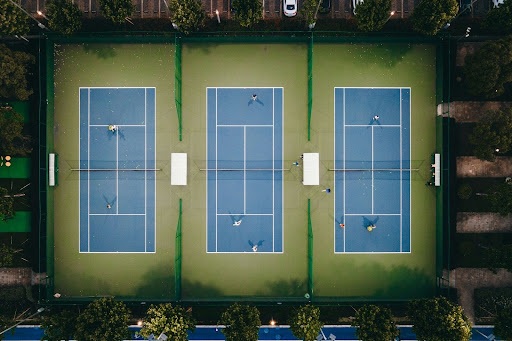
Outdoor multi-court blocks present problems with the real layout. You can provide four poles per court, or you can share poles across courts in order to save money. Shared poles save on hardware, but if not carefully planned scattered reflections on the cross-court might be higher due to improper management of beam angles and optics.
I got involved helping a little club compare two for two courts. Individual poles per court were more expensive at the outset but provided for more uniformity and fewer shadows over the court. Shared center poles saved on steel and foundations but required more careful aiming of the optics and more careful accounting of lighting of one court and blinding the players on the next court.
Height to be mounted is also important. Taller poles and the appropriate optics usually make for a decrease in glare and increase in quality lighting.
Layouts and Indoor Multi-Court Tennis Facilities
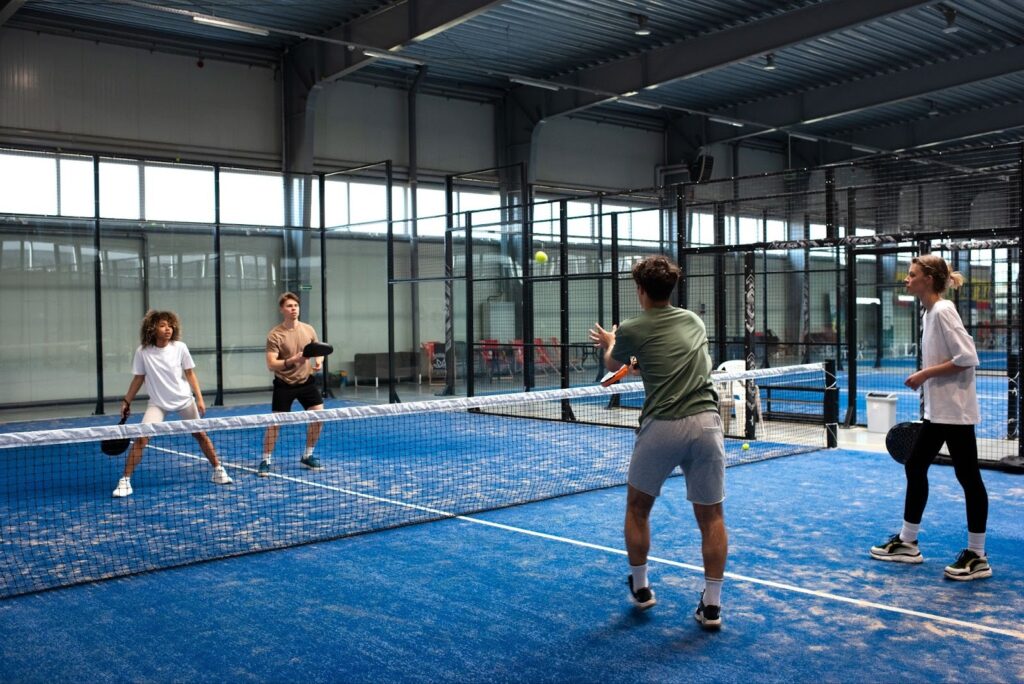
Image by freepik
Indoors, your “sky” is a roof structure which often fights you. Trusses, HVAC, and low beams restrict match locations to hang luminaires. I went to one facility where the original installer just followed the grid of the roof. Result, some courts bright affair stripes and other some duller flat light falls.
A better idea is to plan fixture rows in regard to court lines, not merely building steel. Parallel rows along the sidelines tend to work, but you must have consistent spacing from court to court.
Reflections are another layer. Reflective lights which bounce from glossy walls or windows could cause player and spectator distraction Sometimes adding lighter colored finish to the readings of matte finished walls or optics with tighter beam angles avoids more problems than adding extraneous fixtures.
Choosing LED Fixtures for Multi Court Tennis Facilities
LED technology brought a change to the world of sports lighting, but not all LED lighting fixtures are appropriate for tennis. For this reason, you want just enough lumen production, appropriate beam angles for baselines and center court zones, and good glare.
Color temperature that is around 4000K to 5000K tends to achieve crisp visibility without looking harsh. A decent color rendering index facilitates the players to see the ball clearly and make accurate line calls.
On one project, we replaced old metal halide with LEDs and cut that project’s power use by about half. Maintenance costs were reduced as well, since the staff no longer had to have a lift every season. Over the course of a couple of years, that adjustment was a tradeoff that paid for the improvement in the level of lighting for both practices and matches nights.
Control Systems and Zoning Multi Court Layouts

Image by pvproductions on Freepik
Controls are where your lighting systems begin to realize that they are smart and not stubborn. In a facility with more than one court, you would like to have each court or small group of courts in their own zone. That way, you are just lighting up the courts that are being used.
I worked with one club that used to turn everything on at 5 pm. Eight courts Full brightness Even if only two courts were booked Having done zoning and even simple presets, they were able to run training sessions at a reduced level of lighting and turned on extra courts only when they were needed. Their energy efficiency was enhanced and staff found it easier to manage books.
Simple wall panels where employees can clearly see which label each item is, usually works better than your fancy app that no one wants to learn how to use.
Budgeting and Lifespan Costs
When you budget, it is tempting to concentrate on fixture cost and poles. I would prod you to look at 10 years instead.
Compare overall power consumption, anticipated working hours and maintenance. LED sports lighting typically is a winner when it comes to energy efficiency and long-term reliability, because consider the added bonus of less lamp changes and lift rentals. I have seen payback periods in the range of four to eight-years, but this is dependent on tariffs and usage.
If it is not possible to afford to upgrade everything simultaneously, you can phase upgrades. Many facilities begin with their show courts, working their way down to improvements throughout by rolling in improvements with the revenue and savings accrued.
Common Layout Errors of Multiple Court Tennis Facilities
I see the same mistakes being made over and over. The first is the underestimation of uniformity between courts. Center courts receive good illumination whereas outer courts are dull. Players change when they play a tennis match and instantly notice the difference.
Another mistake is making an effort to save money with too few poles. That tends to cause awkward aiming, increased glare and additional fixtures later bolted on. In one project, the club actually ended up spending more on fixes than they would have spent upfront for a better layout of the pole.
Another trap is ignoring the environment around. Neighbors complain of spill light and you do end up adding shields and re-aiming at your expense.
Step by Step Implementation Plan for Your Multi Court Lighting Project

Image by freepik
Start by writing down how your facility really functions. How many courts, what level of play, how many hours a week, any streaming / broadcast plans. That makes your lighting requirements.
Next, gather site details. Distances between courts, setbacks to property lines, existing light poles, power capacity and surface type. A hard court, black in color, requires different light sentiments than a surface that is whiter in color.
Then, work with a specialist. Ask for photometric layouts for each of the courts, with specific data on the lux, uniformity, and glare. Look at the options, ask yourself anything that doesn’t look right and consider what can be expanded in the future. Good tennis court lighting design should not lock you into a corner.
Case Studies, Multiple Court Tennis Lighting Projects
A four court outdoor club that I worked with had old metal halide fixtures on short poles. Average light levels were in the order of 250 lux with poor uniformity. After a redesign with higher poles, LED lights, and common poles between courts, average levels came to around 450 lux with far more uniformity. Evening bookings increased because players finally trusted the quality of the lighting.
Another project, a six court indoor center, had problems with low roof sections. We used different beam angles and carefully aimed to keep direct light out of the eyes of players, while also covering the playing area. Zoning allowed coaches to run drills on 2 courts at reduced brightness while matches were run at full level on others. Their energy bills were reduced, and feedback from both players and spectator groups improved.
How to Evaluate a Proposed Tennis Court Lighting Design
When a supplier will send a proposal, don’t simply suffer through the brand names. Look for clear drawings of each pole, each fixture and light spread over the courts.
Please check the photometric reports. Is target light levels reached on all courts and not only one? Are uniformity ratios reasonable or are there big jumps from one area to the next?
Then ask questions. How many other similar tennis lighting projects has the Contractor completed? Can they show some photos or references? What are the Warranty terms on Luminaires, Poles and Controls? A good partner will be able to answer directly and help you make changes to the design prior to any build taking place.
FAQs for Lighting Layout of Multi-Court Tennis Facilities
What should your light level be? For casual use playing around, around 300 lux is often good. For club competition, it looks closer to 500 lux.
Number of poles, how many for two to four outdoor courts? Many layouts introduce four-pole-per-court, or shared poles between courts to allow a reduction in hardware.
Can you reuse existing poles? Sometimes, if the structure and locations are amenable for the new layout. On older poles a check for structural issues may be needed.
How do you reduce glare? Use of taller poles, aiming carefully, shields where necessary, and optics that control direct light.
What does it take to pay back LED Upgrades? Often between four and eight years depending on energy prices, hours of use and previous systems.