

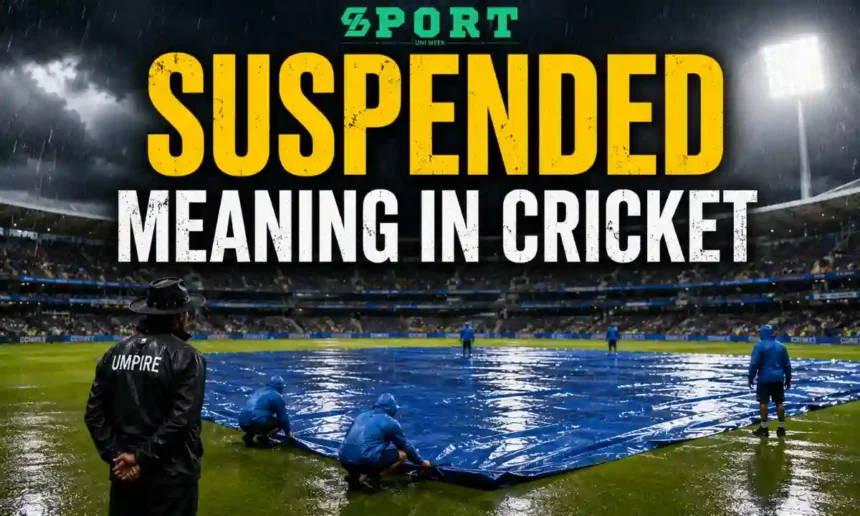
Cricket is a game that depends on weather, playing conditions, and player safety. While watching a live match, you may sometimes see the message “Match Suspended” appear on the scoreboard or television screen. Many fans assume this means the match has ended, but that is not true. A suspended match is only a temporary interruption, and the game is expected to continue once conditions become safe again.
A cricket match can be suspended because of heavy rain, lightning, poor light, an unsafe pitch, crowd disturbances, technical failures, or other unexpected situations. During this period, the score, wickets, and overs already completed remain valid. Once officials decide it is safe to continue, the match resumes from the exact point where it stopped.
This guide explains the complete meaning of suspended in cricket, why matches are suspended, what happens during the interruption, and how it differs from other match statuses.
What Does Suspended Mean in Cricket?
In cricket, the word “suspended” means that the match has been temporarily stopped by the umpires or match referee. The interruption is not permanent, and the intention is to restart the game as soon as conditions improve.
A suspended match is different from an abandoned or cancelled match because the contest is still considered active. The teams simply wait until the reason for the suspension has been resolved.
Suspended Match at a Glance
| Term | Meaning |
|---|---|
| Suspended Match | Play is temporarily stopped but expected to resume later. |
| Match Continues? | Yes |
| Scores Count? | Yes |
| Overs Count? | Yes |
| Final Result Declared? | No, until play is completed or official rules apply |
Suspended Meaning in Simple Words
The easiest way to understand a suspended match is to imagine pressing the pause button during a game.
For example, if a T20 team has scored 112 runs for 3 wickets after 12.2 overs and heavy rain begins, the umpires may stop play. Players leave the field while the ground staff covers the pitch and removes water from the outfield.
When conditions become safe again, the match resumes from 112/3 after 12.2 overs, unless the playing conditions require the number of overs to be reduced.
Why Is a Cricket Match Suspended?
A cricket match is suspended whenever officials believe continuing the game would be unsafe or unfair. The decision is made by the umpires after carefully assessing the playing conditions.
Common Reasons for Match Suspension
| Reason | Explanation |
|---|---|
| Heavy Rain | The pitch or outfield becomes too wet for safe play. |
| Lightning | Play is stopped immediately to protect players and officials. |
| Bad Light | Visibility becomes too poor for safe batting and bowling. |
| Unsafe Pitch | Moisture or damage creates dangerous playing conditions. |
| Crowd Disturbance | Security concerns require play to be halted. |
| Floodlight Failure | Poor lighting prevents safe continuation of the match. |
| Medical Emergency | A serious incident involving players, officials, or spectators. |
| Natural Disaster | Extreme weather or other emergencies make play impossible. |
Heavy Rain
Rain is the most common reason for a suspended cricket match.
A wet field increases the risk of injuries because players can slip while running, bowling, or fielding. Fast bowlers may lose their footing during the run-up, while fielders chasing the ball can easily fall on a slippery outfield.
For this reason, umpires suspend play until the ground becomes safe. If enough time remains, the match resumes, and in limited-overs cricket, the total number of overs may be reduced if necessary.
Lightning and Dangerous Weather
Lightning is treated as a serious safety risk in modern cricket.
Even if rain has not started, nearby lightning can endanger players standing in an open field. As soon as lightning is detected within the safety zone, officials suspend play immediately.
The match only resumes after weather conditions improve and it is considered safe for everyone to return to the field.
Bad Light
Bad light usually affects longer-format cricket, especially Test and first-class matches.
When natural light becomes too poor for players to clearly see the ball, batting and bowling become unsafe. Fast bowlers delivering at high speeds increase the risk even further.
If visibility does not improve, the umpires suspend play until conditions become suitable again or continue the match on the following day if required.
Unsafe Playing Surface
The condition of the pitch and outfield plays an important role in every cricket match.
Officials may suspend play if:
- The pitch becomes excessively wet.
- Dangerous cracks appear on the surface.
- The ball begins bouncing unpredictably.
- The bowler’s landing area becomes slippery.
Player safety is always given priority over completing the scheduled overs.
Crowd Disturbance or Security Issues
Although uncommon, matches can also be suspended because of crowd-related incidents.
Some situations include:
- Spectators entering the field.
- Objects being thrown onto the ground.
- Security threats inside or around the stadium.
- Public disturbances affecting the safety of players and officials.
Play resumes only after security authorities confirm that the venue is completely safe.
Floodlight Failure
Many international and domestic matches are played under floodlights.
If one or more floodlight towers stop working because of technical problems or a power outage, visibility may become too poor for safe play. In such cases, the umpires suspend the match until the lighting system is fully restored.
Can a Suspended Match Resume?
Yes. A suspended match is expected to continue once the issue causing the interruption has been resolved.
If enough playing time remains:
- Players return to the field.
- The match continues from the same score.
- Remaining overs are adjusted if required.
- Tournament playing conditions determine whether the target needs to be revised.
What Happens During a Match Suspension?
Even though the players leave the field, several important activities continue while the match is suspended.
| Activity | Purpose |
|---|---|
| Pitch Covers | Protect the playing surface from further damage. |
| Ground Staff | Remove water and improve field conditions. |
| Weather Monitoring | Check if play can restart safely. |
| Field Inspection | Umpires examine the pitch and outfield. |
| Team Planning | Players and coaches discuss strategy. |
| Match Officials | Review playing conditions and possible schedule adjustments. |
Does the Score Reset After Suspension?
No.
A suspended match does not reset the scoreboard.
Everything that happened before the interruption remains officially recorded, including:
- Total runs
- Wickets
- Overs completed
- Batting partnerships
- Bowling figures
- Individual player statistics
When play resumes, the match continues from the exact point where it was suspended, unless competition rules require changes to the remaining overs or playing conditions.
Suspended Match vs Abandoned Match
Many cricket fans use the terms suspended and abandoned interchangeably, but they have completely different meanings. A suspended match is only paused temporarily, while an abandoned match has officially ended and cannot continue.
The table below explains the key differences.
| Feature | Suspended Match | Abandoned Match |
|---|---|---|
| Meaning | Match is temporarily stopped | Match is permanently ended |
| Can Play Resume? | Yes | No |
| Match Status | Still active | Officially finished |
| Score Remains Valid | Yes | Yes, but no further play |
| Result Possible | Yes, if play resumes | Depends on competition rules |
For example, if heavy rain stops play for one hour and the weather improves later, the match is suspended. However, if rain continues for the rest of the day and there is no possibility of restarting, the match may be abandoned.
Suspended Match vs Postponed Match
A suspended match is often confused with a postponed match, but the two situations are very different.
A suspended match has already started before being interrupted. A postponed match, on the other hand, usually has not started at all and is moved to another date or time.
| Feature | Suspended | Postponed |
|---|---|---|
| Match Started? | Yes | Usually No |
| Play Stops? | During the match | Before the match begins |
| New Date Required? | Usually No | Yes |
| Same Score Continues? | Yes | Match starts from the beginning |
Suspended Match vs Cancelled Match
A cancelled match is one that does not take place because of unavoidable circumstances such as severe weather, government restrictions, security concerns, or other emergencies before play begins.
| Feature | Suspended | Cancelled |
|---|---|---|
| Match Begins | Yes | No |
| Temporary Stop | Yes | No |
| Can Resume Later? | Usually Yes | No |
| Official Result | Possible | No result |
ICC Rules for Suspended Matches
The International Cricket Council (ICC) has detailed playing conditions that guide umpires whenever a match is suspended. These rules are designed to ensure player safety and maintain fairness.
Some of the important principles include:
- Umpires have the authority to suspend play if conditions become unsafe.
- Player safety is always the highest priority.
- The match resumes only after officials inspect the pitch and outfield.
- All runs, wickets, and overs completed before suspension remain official.
- If overs need to be reduced in limited-overs cricket, tournament regulations are followed.
- Every effort is made to produce a result whenever possible.
What Happens to the Score During Suspension?
One of the biggest questions among cricket fans is whether the score changes after a suspension.
The answer is No.
Everything achieved before the interruption remains exactly the same.
This includes:
- Total team score
- Individual batting scores
- Wickets lost
- Overs completed
- Bowling figures
- Extras
- Partnerships
- Fall of wickets
The scoreboard simply pauses until play resumes.
What Happens If Overs Are Reduced?
In limited-overs cricket, a long interruption may leave insufficient time to complete the scheduled number of overs.
In such cases:
- Officials calculate the remaining available playing time.
- The total overs for one or both teams may be reduced.
- If the second innings has already started, the target score may also change according to the competition’s playing conditions.
The objective is to keep the contest fair while allowing the match to finish within the available time.
Suspension Rules in Test Cricket
Test cricket has more flexibility because matches are played over multiple days.
If play is suspended due to rain or bad light:
- Players leave the field.
- The match resumes when conditions improve.
- Lost time may sometimes be recovered later in the day.
- If enough time cannot be recovered, play continues on the next scheduled day.
Since Test matches are spread across five days, temporary suspensions are quite common.
Suspension Rules in One Day Internationals (ODIs)
ODI matches have a fixed schedule, so long interruptions affect the number of overs more significantly.
If play is suspended:
- Officials wait for conditions to improve.
- Available playing time is recalculated.
- Overs may be reduced.
- Revised targets may be set if required.
- If insufficient overs can be completed, the match may end without a result, depending on tournament regulations.
Suspension Rules in T20 Cricket
T20 cricket operates under tighter time limits because each team is scheduled to bat only 20 overs.
When a match is suspended:
- Ground staff work quickly to prepare the field.
- Officials assess the remaining available time.
- Overs are reduced if necessary.
- Teams continue from the existing score once play resumes.
Because T20 matches are shorter, even a relatively brief delay can have a significant impact on the playing conditions.
Can Players Leave the Stadium During Suspension?
Generally, players remain inside the stadium while the match is suspended.
During the break they may:
- Rest in the dressing room.
- Discuss strategies with coaches.
- Receive medical treatment if required.
- Warm up again before play restarts.
- Stay updated on weather conditions.
Players are informed well in advance before returning to the field.
Who Decides to Suspend a Cricket Match?
The decision is not made by the players or team captains alone.
Several officials work together to determine whether play should continue.
| Official | Responsibility |
|---|---|
| On-field Umpires | Assess playing conditions and stop or restart play. |
| Match Referee | Oversees compliance with playing conditions. |
| Ground Staff | Prepare the pitch and outfield for safe play. |
| Tournament Officials | Assist with scheduling and competition regulations. |
| Weather Experts | Provide forecasts when required. |
The final decision to suspend or resume play rests with the on-field umpires after considering all safety factors.
Does a Suspended Match Affect Player Statistics?
No.
Every statistic recorded before the suspension remains part of the official match record.
This includes:
- Runs scored
- Wickets taken
- Strike rates
- Economy rates
- Centuries and half-centuries
- Bowling milestones
- Fielding records
If the match resumes later, players simply continue building on those statistics from the point where play stopped.
Famous Examples of Suspended Cricket Matches
Cricket has witnessed many memorable matches that were temporarily suspended because of weather, technical issues, or unexpected events. In most cases, the matches resumed later, while some eventually ended without a result because conditions did not improve.
Notable Suspended Cricket Matches
| Tournament | Reason for Suspension | Final Outcome |
|---|---|---|
| ICC Cricket World Cup | Heavy rain | Match resumed or result decided according to tournament rules |
| ICC Champions Trophy | Persistent rain | Play delayed and overs reduced |
| Indian Premier League (IPL) | Rain or lightning | Match resumed after interruption whenever possible |
| International Test Matches | Bad light | Play resumed later the same day or the following day |
| Domestic Cricket Leagues | Floodlight failure | Match restarted after technical issues were resolved |
These examples show that suspension is a normal part of cricket and is handled according to the competition’s playing conditions.
Does Suspension Affect the Match Result?
A suspended match does not automatically affect the final result. The outcome depends on whether the game can be completed within the available time.
Possible outcomes include:
- The match resumes and finishes normally.
- The number of overs is reduced.
- A revised target is used if required.
- The match ends without a result if there is insufficient time to continue.
- In knockout tournaments, reserve day rules may apply where available.
How Long Can a Match Remain Suspended?
There is no fixed time limit for a suspension. The duration depends on the reason for the interruption and the amount of playing time remaining.
For example:
| Reason | Possible Duration |
|---|---|
| Passing Shower | 20–40 minutes |
| Heavy Rain | 1–3 hours |
| Lightning | Until the area is declared safe |
| Bad Light | Until visibility improves |
| Technical Failure | Until repairs are completed |
Officials continuously monitor conditions before deciding whether play can restart.
Why Player Safety Comes First
Modern cricket places great importance on player welfare. Even if fans are eager to see the match continue, officials will not restart play unless the conditions are completely safe.
Some major safety concerns include:
- Slippery outfields causing injuries.
- Wet bowling run-ups increasing the risk of falls.
- Lightning strikes in open grounds.
- Poor visibility affecting batsmen and fielders.
- Unsafe pitch conditions leading to unpredictable bounce.
Protecting players, umpires, and spectators is always more important than completing a match on time.
Common Misconceptions About Suspended Matches
Many new cricket fans misunderstand what a suspended match actually means. Here are some common myths and the correct facts.
| Myth | Reality |
|---|---|
| Suspended means the match is over. | No, the match is only paused. |
| The score starts again from zero. | No, all scores remain valid. |
| Suspension always leads to abandonment. | Not necessarily; many matches resume successfully. |
| Players decide when to stop play. | The on-field umpires make the final decision. |
| Suspension only happens because of rain. | It can also happen due to lightning, bad light, security issues, or technical problems. |
Tips for Cricket Fans During a Suspended Match
If you’re watching a match that has been suspended, here are a few things to keep in mind:
- Follow official match updates for restart announcements.
- Do not assume the match has ended.
- Be prepared for reduced overs in limited-overs cricket.
- Understand that the score will continue from the same point.
- Keep an eye on weather conditions if rain is the reason for suspension.
FAQs
What does suspended mean in cricket?
A suspended match is one that has been temporarily stopped because conditions are unsafe or unsuitable for play. The match is expected to resume once the issue has been resolved.
Is a suspended match the same as an abandoned match?
No. A suspended match is only paused, while an abandoned match is officially ended and cannot continue.
Does the score change after a suspension?
No. All runs, wickets, overs, and player statistics remain exactly the same when the match resumes.
Who decides to suspend a cricket match?
The on-field umpires make the decision after assessing the pitch, outfield, weather, visibility, and overall safety.
Can a suspended match continue the next day?
Yes. In multi-day matches such as Test cricket, play may continue on the following day. In some tournaments, reserve days may also be used if provided in the competition rules.
Is rain the only reason a cricket match can be suspended?
No. Matches may also be suspended because of lightning, bad light, dangerous pitch conditions, crowd disturbances, floodlight failures, medical emergencies, or other safety concerns.
Are player statistics affected by suspension?
No. Every run, wicket, catch, and other statistic recorded before the suspension remains part of the official match record.
Conclusion
Understanding the suspended meaning in cricket helps fans better follow the game when unexpected interruptions occur. A suspended match is simply a temporary pause, not the end of the contest. Whether the interruption is caused by rain, lightning, poor light, security concerns, or technical issues, the main goal is to protect everyone involved while preserving the fairness of the match.
In most cases, play resumes from the exact point where it stopped, with all scores and statistics remaining unchanged. Only if conditions fail to improve or there is not enough time left will officials consider other outcomes based on the tournament’s playing conditions. Knowing the difference between suspended, abandoned, postponed, and cancelled matches makes it much easier to understand live cricket updates and official match announcements.
Also, Read About; Most Fan Following IPL Team All Time || Most Fan Base Team in IPL || Fastest Stumping in IPL