

Women’s cricket has changed dramatically over the last few decades, particularly in fitness, athleticism and fast bowling. Modern pace bowlers are not only capable of swinging the new ball and hitting difficult lengths but are also producing speeds that were once rarely associated with the women’s game. Among all these performances, one delivery stands above the rest in the era of recorded bowling speeds.
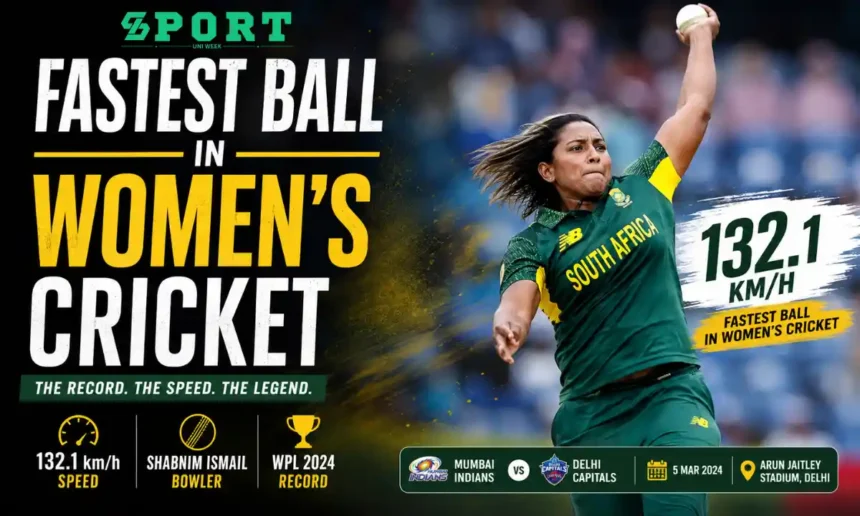
The fastest recorded ball in women’s cricket is 132.1 km/h (82.08 mph), bowled by former South African fast bowler Shabnim Ismail. She produced the record-breaking delivery while representing Mumbai Indians against Delhi Capitals in the Women’s Premier League (WPL) on 5 March 2024 at the Arun Jaitley Stadium in Delhi.
The delivery was significant because it was the first officially reported instance of a ball in women’s cricket crossing the 130 km/h barrier. Ismail had already established herself as one of the quickest bowlers of her generation, but this delivery gave her a special place in cricket history.
Fastest Ball in Women’s Cricket – Quick Overview
Shabnim Ismail’s record came after years of consistently high-speed bowling at international and franchise level. Even before the WPL record, she had repeatedly been clocked at speeds above 125 km/h. Her combination of an explosive run-up, powerful action and competitive approach made genuine pace the central feature of her bowling.
| Detail | Information |
|---|---|
| Fastest Recorded Ball | 132.1 km/h |
| Speed in Miles Per Hour | 82.08 mph |
| Bowler | Shabnim Ismail |
| Country | South Africa |
| Bowling Style | Right-arm fast |
| Team | Mumbai Indians |
| Opponent | Delhi Capitals |
| Tournament | Women’s Premier League (WPL) |
| Year | 2024 |
| Date | 5 March 2024 |
| Venue | Arun Jaitley Stadium, Delhi |
| Batter Facing Delivery | Meg Lanning |
| Major Achievement | First recorded women’s delivery above 130 km/h |
Who Bowled the Fastest Ball in Women’s Cricket?
Shabnim Ismail holds the record for the fastest officially recorded delivery in women’s cricket. The former South African pacer reached 132.1 km/h while playing for Mumbai Indians during the 2024 Women’s Premier League.
Ismail had already retired from international cricket by the time she produced the record. However, she continued playing franchise cricket, where her speed remained one of her greatest strengths.
Her pace was never based solely on physical strength. Her bowling action featured a quick approach to the crease, strong momentum, rapid arm speed and an aggressive follow-through. These qualities allowed her to generate exceptional pace despite not having the towering frame often associated with express fast bowling.
Shabnim Ismail’s 132.1 km/h Record-Breaking Delivery
The historic moment occurred during the WPL match between Mumbai Indians and Delhi Capitals on 5 March 2024.
Ismail was bowling the third over of Delhi Capitals’ innings. On the second delivery of the over, she sent down a full ball to former Australian captain Meg Lanning.
Lanning missed the delivery and was struck on the front pad. Mumbai Indians appealed for LBW, but the umpire rejected the appeal.
The delivery itself did not result in a wicket. What happened immediately afterward, however, turned it into a historic cricketing moment. The broadcast speed gun displayed:
132.1 km/h
That number represented a new benchmark for women’s cricket.
It was reported as the first recorded delivery in the women’s game to break the 130 km/h barrier.
Fastest Ball in Women’s Cricket Record Details
| Record Detail | Information |
|---|---|
| Bowler | Shabnim Ismail |
| Maximum Recorded Speed | 132.1 km/h |
| MPH | 82.08 mph |
| Match | Mumbai Indians vs Delhi Capitals |
| Competition | WPL 2024 |
| Delivery | Second ball of the third over |
| Batter | Meg Lanning |
| Result of Delivery | Hit batter on pad |
| Venue | Arun Jaitley Stadium |
| Location | Delhi, India |
| Historical Importance | First recorded women’s delivery over 130 km/h |
Why Was the 132.1 km/h Delivery So Special?
Bowling quickly is only one component of fast bowling, but crossing a previously untouched speed barrier carries special significance. In women’s cricket, the 130 km/h mark had long represented an exceptional level of pace.
Shabnim Ismail did not merely approach that figure. Her recorded speed of 132.1 km/h moved clearly beyond it.
The record also came during a major franchise competition with modern broadcast technology and speed tracking. That made the achievement measurable and widely documented.
Perhaps even more impressively, Ismail achieved the feat after retiring from international cricket. Her performance demonstrated how experienced fast bowlers can retain elite speed through careful workload management, conditioning and technique.
How Fast Is 132.1 km/h in MPH?
A bowling speed of 132.1 km/h is approximately 82.08 mph.
At this velocity, the batter has only a fraction of a second to identify the line and length of the delivery, decide which shot to play and execute the movement. Reaction time becomes particularly important when pace is combined with swing, seam movement or an accurate short ball.
| Speed Measurement | Value |
|---|---|
| Kilometres Per Hour | 132.1 km/h |
| Miles Per Hour | 82.08 mph |
| Metres Per Second | Approx. 36.7 m/s |
| Record Category | Fastest recorded women’s cricket delivery |
Shabnim Ismail – The Fastest Bowler in Women’s Cricket
Shabnim Ismail was born on 5 October 1988 in Cape Town, South Africa. She developed into one of South Africa’s greatest fast bowlers and became internationally recognised for her speed, aggression and ability to attack batters with the new ball.
Unlike fast bowlers who rely mainly on height and bounce, Ismail generated much of her pace through an explosive action. Her run-up built momentum rapidly before a powerful delivery stride transferred that energy into the ball.
She represented South Africa across all three international formats and became a central figure in the development of the country’s women’s cricket team.
Shabnim Ismail Profile
| Information | Details |
|---|---|
| Full Name | Shabnim Ismail |
| Date of Birth | 5 October 1988 |
| Birthplace | Cape Town, South Africa |
| Nationality | South African |
| Role | Bowler |
| Batting Style | Left-handed |
| Bowling Style | Right-arm fast |
| International Team | South Africa |
| International Career | 2007–2023 |
| Fastest Recorded Delivery | 132.1 km/h |
| WPL Team at Time of Record | Mumbai Indians |
Shabnim Ismail’s Previous Speed Records
The 132.1 km/h delivery was not an isolated burst of pace. Ismail had demonstrated her ability to reach exceptional speeds for many years.
According to ICC reporting, she had previously been clocked at approximately 128 km/h against West Indies in 2016. She was also recorded at around 127 km/h on two occasions during the 2022 ICC Women’s Cricket World Cup.
During the opening match of WPL 2024, she also registered a delivery at approximately 128.3 km/h against Delhi Capitals.
This history is important because it shows that the 132.1 km/h delivery was the peak of a long-standing pattern rather than a completely unexpected speed-gun reading.
Shabnim Ismail Fastest Bowling Speeds
| Period/Event | Recorded Speed |
|---|---|
| WPL 2024 vs Delhi Capitals | 132.1 km/h |
| WPL 2024 Opening Match | 128.3 km/h |
| International Cricket vs West Indies, 2016 | 128 km/h |
| Women’s Cricket World Cup 2022 | 127 km/h |
| Women’s Cricket World Cup 2022 | 127 km/h |
First Woman to Bowl Over 130 km/h
Shabnim Ismail became the first woman officially recorded bowling above 130 km/h when the speed gun registered 132.1 km/h during WPL 2024.
The importance of this milestone goes beyond a single number. Fast bowling standards in the women’s game have risen alongside professional contracts, improved strength and conditioning, specialist coaching, workload management and the expansion of elite domestic competitions.
The 130 km/h barrier therefore represents an important marker in that progression.
How Shabnim Ismail Generates Extreme Pace
Fast bowling requires the coordination of the entire body. A bowler cannot generate elite speed through arm strength alone. Momentum begins during the run-up and passes through the lower body, hips, torso, shoulder and bowling arm before being transferred into the ball.
Ismail’s action was particularly effective because of its explosive rhythm. Her quick approach created momentum before a powerful final stride and rapid arm rotation helped convert that momentum into ball speed.
She was also highly competitive. Rather than treating pace as an occasional weapon, Ismail built her identity around consistently making batters uncomfortable.
Is Shabnim Ismail Still Playing International Cricket?
No. Shabnim Ismail announced her retirement from international cricket in May 2023, ending a long career with South Africa.
However, international retirement did not immediately mean retirement from all cricket. She continued participating in franchise competitions.
Remarkably, the fastest recorded delivery of her career came after her international retirement, during WPL 2024.
That makes the record particularly unusual: one of the most important pace milestones in women’s cricket was achieved by a player who had already completed her international career.
Fastest Ball in Women’s International Cricket
This topic needs an important distinction.
The 132.1 km/h delivery was bowled in the Women’s Premier League, which is franchise T20 cricket rather than an international match.
Before that record, Ismail had already produced extremely fast deliveries while representing South Africa. ICC reporting notes that she reached approximately 128 km/h against West Indies in 2016 and around 127 km/h during the 2022 Women’s Cricket World Cup.
Therefore, searches for the “fastest ball in women’s cricket” and “fastest ball in women’s international cricket” should not automatically be treated as exactly the same record category.
Why Historical Fastest-Bowler Lists Can Differ
Lists ranking the fastest female bowlers should be interpreted carefully.
Modern international tournaments and franchise leagues frequently use sophisticated broadcast speed guns and ball-tracking systems. Older generations did not receive the same level of consistent measurement.
Consequently, historical claims about the exact maximum speeds of bowlers such as Cathryn Fitzpatrick may vary between publications.
For this reason, fastest recorded delivery is a more precise description of Shabnim Ismail’s 132.1 km/h achievement than claiming that every delivery bowled throughout the entire history of women’s cricket has been measured under identical conditions.
Other Famous Fast Bowlers in Women’s Cricket
Although Shabnim Ismail owns the headline speed record, women’s cricket has produced numerous outstanding pace bowlers.
Cathryn Fitzpatrick
Former Australian fast bowler Cathryn Fitzpatrick was one of the most feared pace bowlers of her generation. She played during an era when speed tracking was far less consistent than it is today, making exact historical comparisons difficult.
Fitzpatrick was nevertheless widely regarded as exceptionally quick and helped establish a benchmark for genuine pace in women’s cricket.
Ellyse Perry
Australian all-rounder Ellyse Perry has combined pace bowling with world-class batting throughout an extraordinary career. During the earlier stages of her career, Perry was especially noted for her speed.
She remains one of the most influential all-round cricketers in the history of the women’s game.
Jhulan Goswami
For Indian cricket fans, Jhulan Goswami is one of the most recognisable names associated with fast bowling.
The tall Indian pacer used her height, bounce, accuracy and seam movement to trouble batters for approximately two decades. Her influence went far beyond statistics because she inspired a generation of Indian girls to view fast bowling as a serious career path.
Lea Tahuhu
New Zealand’s Lea Tahuhu has built a reputation around aggressive fast bowling and the ability to produce significant pace.
At her best, she has been among the quickest bowlers in international women’s cricket and has provided New Zealand with an important strike-bowling option.
Darcie Brown
Australia’s Darcie Brown represents the newer generation of genuine fast bowlers.
Her combination of height, pace and bounce has made her particularly dangerous with the new ball. She demonstrates how modern high-performance systems are developing young fast bowlers capable of maintaining significant speeds.
Tayla Vlaeminck
Australian pacer Tayla Vlaeminck has frequently attracted attention because of her natural speed.
Injury interruptions have affected parts of her career, but when fully fit she has been recognised as one of the fastest bowlers of her generation.
Lauren Filer
England’s Lauren Filer is another important name in the modern pace-bowling conversation. Her natural ability to generate speed and bounce gives England an attacking option capable of challenging batters through genuine pace.
Fastest Women Bowlers – Why Exact Rankings Need Caution
Numerous online lists provide precise top-five or top-ten rankings of women’s fast bowlers. However, those lists often disagree about the maximum recorded speeds of individual players.
The safest historical comparison is therefore to separate well-documented modern speed-gun records from estimates or reports relating to older eras.
| Bowler | Country | Known For |
|---|---|---|
| Shabnim Ismail | South Africa | 132.1 km/h officially reported record |
| Cathryn Fitzpatrick | Australia | Exceptional pace in an earlier era |
| Ellyse Perry | Australia | Pace and elite all-round ability |
| Tayla Vlaeminck | Australia | Natural express pace |
| Darcie Brown | Australia | Speed and bounce |
| Jhulan Goswami | India | Pace, bounce and longevity |
| Lea Tahuhu | New Zealand | Aggressive fast bowling |
| Katherine Sciver-Brunt | England | Pace, aggression and control |
| Lauren Filer | England | Modern high-speed fast bowling |
Fastest Ball in Women’s Cricket by an Indian Bowler
When discussing Indian women’s fast bowling, Jhulan Goswami remains the defining historical name.
Goswami combined height with a high-arm action that produced bounce and movement. She was not simply successful because she could bowl quickly; she developed exceptional control, seam movement and tactical awareness.
Rather than relying on unverified exact speed figures, it is more accurate to describe Goswami as one of the fastest and most influential Indian women’s pacers of her era.
Her legacy is particularly important because India now has a broader pipeline of pace bowlers benefiting from professional domestic cricket, improved training facilities and competitions such as the WPL.
Shabnim Ismail vs Jhulan Goswami
Both Shabnim Ismail and Jhulan Goswami were legendary fast bowlers, but their methods were different.
| Comparison | Shabnim Ismail | Jhulan Goswami |
|---|---|---|
| Country | South Africa | India |
| Primary Role | Fast Bowler | Fast Bowler |
| Bowling Style | Right-arm Fast | Right-arm Medium-Fast |
| Major Strength | Extreme pace and aggression | Bounce, seam and accuracy |
| Career Character | Explosive strike bowler | Consistent long-term spearhead |
| Fastest Recorded Highlight | 132.1 km/h | Historical figures vary by source |
| International Status | Retired | Retired |
Ismail was more closely associated with raw speed, whereas Goswami’s greatness came from a broader combination of bounce, movement, accuracy, endurance and longevity.
Women’s Cricket Fast Bowling Has Become Quicker
The development of women’s cricket has created better conditions for fast bowlers to improve.
Professional contracts allow athletes to train throughout the year. Strength-and-conditioning specialists can build explosive power while sports scientists monitor workloads. Improved nutrition and recovery programs help bowlers sustain demanding training schedules.
Franchise leagues such as the WPL and Women’s Big Bash League have added another layer. Bowlers now compete against elite international batters more regularly, encouraging them to develop additional speed, variations and tactical skills.
As investment continues to increase, more young bowlers are likely to approach speeds that were once considered exceptional.
Importance of the Women’s Premier League in Fast Bowling
The WPL has rapidly become an important competition in women’s cricket.
It places leading Indian players alongside international stars and provides access to high-quality coaching, training environments, broadcast technology and competitive pressure.
Shabnim Ismail’s record is a good example of what franchise cricket can showcase. A major women’s competition provided the stage, modern speed-measurement technology recorded the delivery, and a global audience immediately saw a historic performance.
The league can also influence future Indian fast bowlers by giving young players regular exposure to elite pace bowling.
How Is Bowling Speed Measured in Cricket?
Modern cricket broadcasts generally use specialised tracking and radar-based technology to estimate the speed of the ball shortly after it leaves the bowler’s hand.
The measurement represents release speed rather than the velocity of the ball when it reaches the batter.
A cricket ball loses speed while travelling down the pitch because of air resistance and its interaction with the surface after bouncing. Therefore, a delivery displayed at 132.1 km/h does not remain at exactly 132.1 km/h throughout its entire journey.
Advances in tracking technology have made modern bowling-speed records much easier to document than those from earlier periods.
Why Pace Matters in Women’s Cricket
Pace reduces a batter’s reaction time. When a bowler combines high speed with accuracy, movement and bounce, scoring becomes considerably more difficult.
However, speed alone does not guarantee wickets.
A fast bowler must also control line and length, use the crease effectively and understand when to deploy yorkers, bouncers, slower balls and seam movement.
Shabnim Ismail was dangerous because she combined pace with aggression and skill rather than simply attempting to bowl every delivery as fast as possible.
Can a Woman Bowl 140 km/h?
No officially documented women’s cricket delivery has yet reached 140 km/h.
The current benchmark of 132.1 km/h means another 7.9 km/h would be required to reach 140 km/h.
That is a substantial increase at elite bowling speeds. Nevertheless, improvements in sports science, professional training, biomechanics, strength development and talent identification may continue to push the record upward.
The 130 km/h barrier once appeared exceptionally difficult. Shabnim Ismail eventually crossed it.
The next generation now has a measurable target.
Could Shabnim Ismail’s Record Be Broken?
Yes. Cricket records are rarely permanent.
Young fast bowlers are receiving professional support earlier in their careers. They have access to better strength programs, biomechanical analysis, recovery strategies and year-round competition.
Australia, England, India, South Africa and New Zealand are among the countries developing increasingly strong pace-bowling groups.
However, breaking 132.1 km/h will require an exceptional combination of natural athleticism, efficient biomechanics, physical conditioning, technique and match conditions.
Until someone officially exceeds that number, Shabnim Ismail remains the holder of the fastest recorded delivery.
Fastest Ball in Women’s Cricket vs Men’s Cricket
The overall cricket speed record is considerably higher than the women’s record.
Pakistan fast bowler Shoaib Akhtar famously produced a delivery recorded at 161.3 km/h (100.23 mph) against England during the 2003 Cricket World Cup.
| Category | Bowler | Recorded Speed |
|---|---|---|
| Women’s Cricket | Shabnim Ismail | 132.1 km/h |
| Men’s Cricket | Shoaib Akhtar | 161.3 km/h |
| Difference | — | 29.2 km/h |
The comparison is interesting statistically, but the more meaningful story is the progression within each game. Women’s fast bowling continues to develop as professionalism and athletic preparation expand.
What Makes an Elite Women’s Fast Bowler?
An elite fast bowler requires much more than maximum speed.
A smooth run-up establishes momentum, while strong lower-body mechanics provide stability and force. Core rotation transfers energy toward the upper body, and fast shoulder and arm movement helps produce release velocity.
Accuracy is equally important. A bowler capable of 125 km/h but unable to control line and length may be less effective than a slightly slower bowler who consistently attacks the stumps and creates movement.
The best pace bowlers combine speed, control, movement, tactical intelligence and durability.
Future of Fast Bowling in Women’s Cricket
The next decade could be one of the most interesting periods ever for women’s pace bowling.
Young players are entering professional systems earlier, while domestic leagues provide greater financial and competitive opportunities. Video analysis and biomechanics allow coaches to improve bowling actions without relying purely on traditional methods.
Strength training is also becoming increasingly specialised. Instead of simply increasing muscle mass, programs can focus on explosive power, mobility, sprint mechanics and efficient force transfer.
These developments could gradually produce more bowlers capable of consistently reaching 125–130 km/h.
Eventually, someone may challenge the 132.1 km/h benchmark.
Interesting Facts About the Fastest Ball in Women’s Cricket
- Shabnim Ismail bowled the record delivery at 132.1 km/h.
- The record was created during WPL 2024.
- She was representing Mumbai Indians.
- The opponent was Delhi Capitals.
- Meg Lanning faced the historic delivery.
- The ball struck Lanning on the pad.
- The LBW appeal was unsuccessful.
- It was the second delivery of the third over.
- Ismail had already retired from international cricket.
- The delivery became the first recorded ball in women’s cricket to exceed 130 km/h.
Conclusion
The fastest recorded ball in women’s cricket is 132.1 km/h (82.08 mph), delivered by South African pace legend Shabnim Ismail for Mumbai Indians against Delhi Capitals during the 2024 Women’s Premier League.
The delivery was historic because it represented the first recorded instance of a woman bowler breaking the 130 km/h barrier. Even more remarkably, Ismail achieved the milestone after retiring from international cricket.
Her record represents more than personal achievement. It illustrates the rapid development of women’s cricket, where improved professionalism, coaching, fitness, sports science and franchise competitions are helping athletes push physical and technical boundaries.
Future fast bowlers will inevitably chase the 132.1 km/h mark. Whether the next milestone is 133, 135 or eventually 140 km/h, Shabnim Ismail will always be remembered as the bowler who officially pushed women’s cricket beyond the 130 km/h barrier.
FAQs
Who bowled the fastest ball in women’s cricket?
Shabnim Ismail of South Africa holds the record for the fastest recorded delivery in women’s cricket. She bowled at 132.1 km/h during the 2024 Women’s Premier League.
What is the fastest ball in women’s cricket?
The fastest officially recorded delivery is 132.1 km/h (82.08 mph), bowled by Shabnim Ismail.
When did Shabnim Ismail bowl 132.1 km/h?
She recorded the speed on 5 March 2024 during a WPL match between Mumbai Indians and Delhi Capitals.
Who faced the fastest ball in women’s cricket?
Former Australian captain Meg Lanning, representing Delhi Capitals, faced Shabnim Ismail’s record-breaking delivery.
Where was the fastest women’s cricket ball bowled?
The delivery was bowled at the Arun Jaitley Stadium in Delhi, India.
Which team was Shabnim Ismail playing for?
She was representing Mumbai Indians in the Women’s Premier League.
Is Shabnim Ismail the first woman to bowl over 130 km/h?
Yes. Her 132.1 km/h delivery was reported as the first recorded delivery in women’s cricket to cross the 130 km/h mark.
Is Shabnim Ismail still playing international cricket?
No. She retired from international cricket in May 2023, although she continued playing franchise cricket afterward.
Who is the fastest Indian woman bowler?
Jhulan Goswami is historically regarded as one of India’s quickest and greatest fast bowlers. Exact historical maximum-speed claims vary across sources, so they should not be treated as directly comparable with modern speed-gun records without reliable measurement data.
Has any woman bowled 140 km/h?
No officially documented delivery in women’s cricket has reached 140 km/h. The recognised recorded benchmark remains Shabnim Ismail’s 132.1 km/h.
What is the difference between the fastest men’s and women’s deliveries?
Shoaib Akhtar’s famous men’s record is 161.3 km/h, while Shabnim Ismail’s women’s record is 132.1 km/h. The numerical difference is 29.2 km/h.
Can the women’s fastest-ball record be broken?
Yes. With increasing professionalism, improved sports science and a new generation of powerful fast bowlers, the 132.1 km/h record could eventually be surpassed.
Also, Read About: Who Is the Best Finisher in the World || ICC Umpires Salary Per Match in Rupees || Indian Cricketers Height in Feet || Fastest Stumping in IPL || Most Fan Base Team in IPL || Most Fan Following IPL Team All Time